
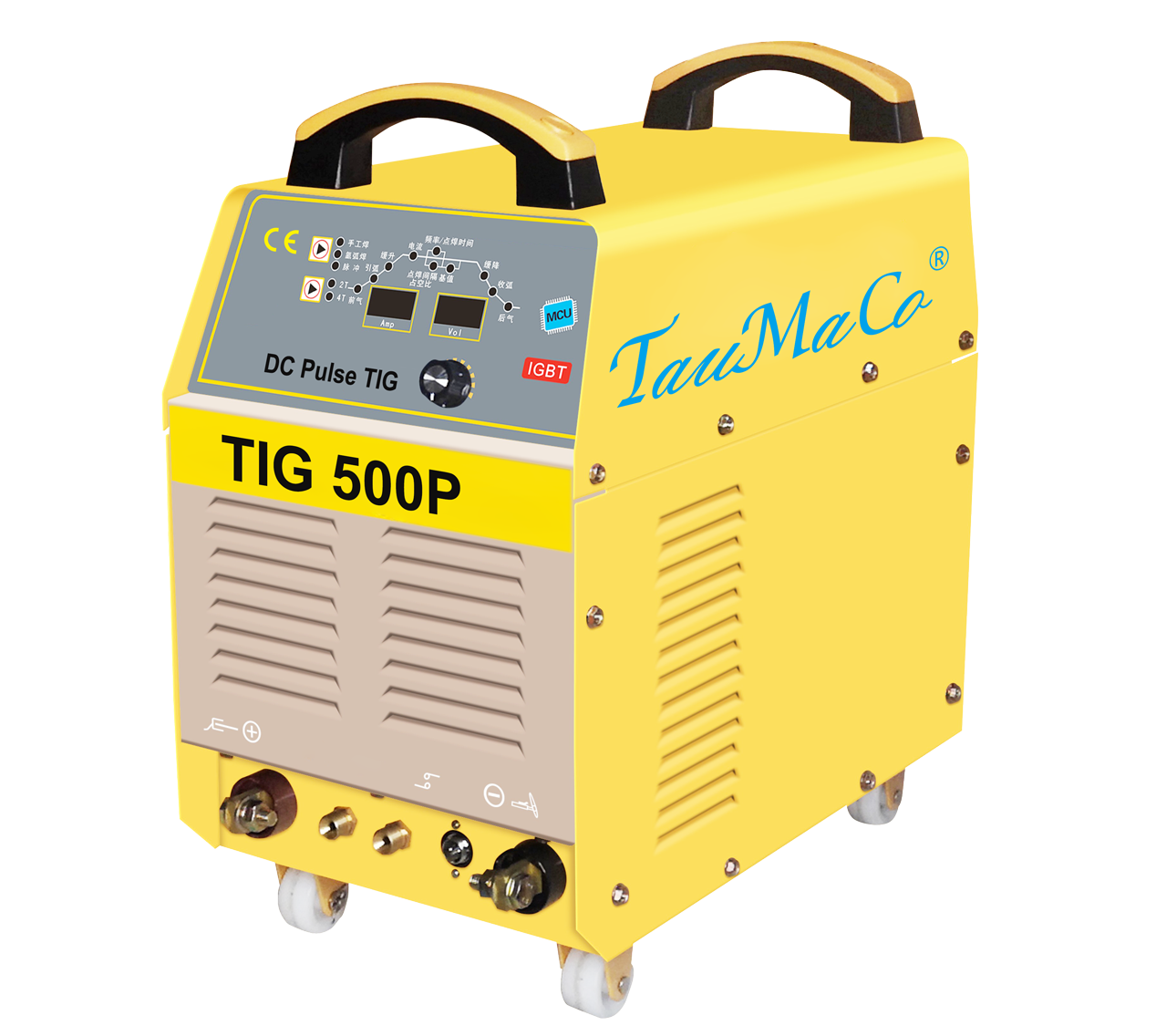
TIG-500P (DC Pulse TIG)
High-output IGBT inverter pulse TIG welding machine with 380V three-phase input, 10-500 A rated output, 60% duty cycle, and concentrated arc performance for stainless steel, alloy steel, carbon steel, and heavier fabrication work.
Built with 100 kHz IGBT inverter technology and a dual-module main circuit to deliver advanced electrical performance, stable arc behavior, concentrated output, and significant energy savings.
TIG-500P (DC Pulse TIG) Technical Specifications
Core electrical data, pulse control range, and physical dimensions for the TIG-500P IGBT inverter pulse TIG welding machine.
| Parameter | TIG-500P (DC Pulse TIG) |
|---|---|
| Welding Process | DC Pulse TIG with MMA function |
| Inverter Technology | 100 kHz IGBT inverter with dual-module main circuit |
| Supply Voltage | 380V ±10% (Three-phase) |
| Rated Frequency | 50/60 Hz |
| Rated Input Power | 24 kVA |
| Maximum Open-Circuit Voltage | 76 V |
| Rated Duty Cycle | 60% |
| Rated Output Current | 10-500 A |
| Pulse Peak Current | 500 A |
| Base Current | 10-500 A |
| Pulse Frequency | 0.1-99.9 Hz |
| Thrust Current | 20-150 A |
| Exterior Dimensions (L×W×H) | 530 × 300 × 532 mm |
| Weight | 28.2 kg |
| Certification | CE |
| Compliance | LVD 2014/35/EU, EMC 2014/30/EU |
High-output pulse control, concentrated arc performance, and heavier industrial fabrication range.
TIG-500P (DC Pulse TIG) combines an advanced IGBT dual-module main circuit, concentrated arc behavior, and integrated MMA capability for special weld requirements and higher-output industrial production work.
100 kHz IGBT inverter technology with dual-module main circuit
The advanced main circuit design delivers good dynamic characteristics, stable output performance, and significant energy savings for demanding welding applications.
Easy arc initiation with concentrated arc performance
Easy arc initiation together with a concentrated arc makes the machine suitable for workpieces that require tighter weld control and higher output consistency.
MMA function with separate output terminals for easy conversion
The machine includes manual arc welding functionality with separately introduced output terminals, helping simplify conversion between pulse TIG and MMA working modes.
Configured for stainless, alloy, carbon steel, and non-ferrous metals
The supplied product information positions this model for stainless steel, alloy steel, carbon steel, and other non-ferrous metal welding applications in broader fabrication work.
Designed to remain practical for outdoor and site operations
The structure is described as suitable for outdoor operation with convenient carrying and deployment relative to its higher-output class, supporting site use as well as workshop installation.
Standardized product positioning
- Model: TIG-500P (DC Pulse TIG)
- Type: IGBT inverter pulse TIG / MMA welding machine
- Input voltage: 380V ±10% (three-phase)
- Output range: 10-500 A
- Duty cycle: 60%
High-output pulse and current control for heavier fabrication
- Pulse peak current: 500 A
- Base current: 10-500 A
- Pulse frequency: 0.1-99.9 Hz
- Thrust current: 20-150 A
- MMA conversion supported through separate output terminals
Built for heavier industrial and outdoor fabrication work
- Stainless, alloy steel, carbon steel, and non-ferrous welding
- Workpieces with more demanding weld seam requirements
- Industrial production and higher-output fabrication tasks
- Outdoor operation where portable deployment is still important
Select compact DC TIG, AC/DC aluminum TIG, or transformer and SCR platforms by output type, cooling, and material demand.
This TIG lineup covers portable DC TIG and MMA inverters, higher-output pulse TIG machines, AC/DC inverter systems for aluminum and non-ferrous work, and transformer or SCR models for conventional workshop and industrial applications.
Portable and production-ready DC TIG machines for steel, stainless steel, repair, and fabrication work
- TIG-200, TIG-250mos, TIG-250D, and TIG-250P cover compact DC TIG and multi-process welding for workshop and field use.
- TIG-315P, TIG-400P, and TIG-500P extend the range for higher-output pulse TIG and industrial fabrication demand.
- Choose this group when DC TIG performance, portability, or wider pulse-control range is the main requirement.
AC/DC TIG systems for aluminum, non-ferrous metals, and higher-duty production welding
- AC-DC-TIG-250P, AC-DC-TIG-315P, AC-DC-TIG-315PW, AC-DC-TIG-500P, and AC-DC-TIG-500PW cover AC/DC TIG across air-cooled and water-cooled formats.
- These models are the preferred choice when aluminum welding, AC output, or longer high-load operating cycles are required.
- Water-cooled versions are better suited to continuous higher-current work where torch temperature and long-run stability matter more.
Conventional transformer-class and SCR-controlled TIG platforms for workshop durability and heavier-duty operation
- AC-DC-TIG-350PT and AC-DC-TIG-500PT serve thicker-section AC/DC TIG applications in transformer-class format.
- TIG-200SCR-1PH-220V, TIG-200SCR-1PH-380V, TIG-250SCR-1PH-380V, and TIG-300SCR-1PH-380V provide transformer SCR DC TIG coverage for conventional workshop use.
- Select this group when traditional machine construction, single-phase transformer supply, or heavier-duty shop use is preferred.
Verify package scope and application suitability before order confirmation.
Published specifications, standard delivery scope, and accessory ratings are for reference only and may change without notice. Included TIG torches, electrode holders, work clamps, gas regulators, flowmeters, water-cooling units, foot pedals, remote controls, plugs, and other accessories may vary by model, package, and destination market. Before supply, confirm the required TIG or MMA process, AC or DC output type, input power, output current, duty cycle, cooling configuration, torch or work-lead length, and applicable local compliance requirements for the intended application.